


Finding the right EHR means asking the right questions. When searching for an EHR, you likely have a list of criteria that are important for your practice.
Perhaps you want to ensure the platform utilizes current technology, is intuitive, or enables efficient reporting and payments. You may also want to understand how well the system fits your specific practice model, whether that’s solo therapy, a growing group practice, telehealth-focused care, or IOP/PHP.
On the surface, it’s hard to distinguish the differences between the platforms you’re evaluating. You need to know what questions to ask that break through the noise and get to the core of the product.
EHR Technology Checklist
We’ve compiled a list of questions to ask when evaluating EHR and Practice Management software vendors. The goal isn’t just to compare features. It’s to understand how well a platform will support your workflows today, how it will scale as your practice grows, and whether it’s truly built for behavioral health.
⬜ Are they architected for a public cloud (e.g., Amazon Web Services) environment, or are they hosted in a private cloud (e.g vendor managed servers) with vendor-managed servers? If the answer isn’t clear, ask the vendor to explain how the system is deployed, maintained, and updated in plain language.
⬜ How quickly are they producing new, high-quality features that are going to be relevant for your specialty? For many EHR platforms that serve multiple specialties, new features tend to be geared towards the most profitable specialties, offering nothing new for those using their platform for behavioral health. A strong answer should show that the vendor is continuing to invest in the platform, not just maintaining older infrastructure.
⬜ When was their foundational technology infrastructure built? Was it within the last 10 years? When was the last time their EHR software was rewritten, rather than just versioned?
⬜ How is their EHR deployed? By client-server, web-hosting, or cloud-native?
⬜ As you grow (more clients, providers, etc.), how does their EHR scale, and how does that impact you? Ask how growth affects workflows, support, and operational complexity, not just whether the system can technically handle more users.
⬜ Does their EHR offer group therapy functionality designed for behavioral health?
⬜ How is the patient experience? Does their EHR provide an intuitive patient portal for all interactions with your practice?
⬜ What kind of telehealth technology does their EHR use? Is it natively integrated, secure, HIPAA-compliant, and easy-to-use? Does it support individual and group therapy?
⬜ Does the EHR offer support for efficient treatment planning?
⬜ How long is their training program? How much product documentation do they provide? How much of it is dedicated to navigating their user interface (UI)? Does the training reflect the real workflows used by clinicians, front-desk staff, billers, and administrators?
⬜ What is their process to create or change forms, workflows, logic, and/or data captured? What are the related costs and typical turnaround times? How flexible is that process as your practice evolves?
⬜ Does their EHR allow you to manage prospective patients? Can you match patients and providers without lots of manual work?
⬜ How predictable are your costs? What is included, and what costs extra in their pricing model? You can compare that against your broader budgeting and package needs on our Plans & Pricing page.
⬜ What is the composition of their company? How many employees are engineers, support staff, sales, etc.? Which is the largest team? How does this affect their technology and/or the support you would receive?
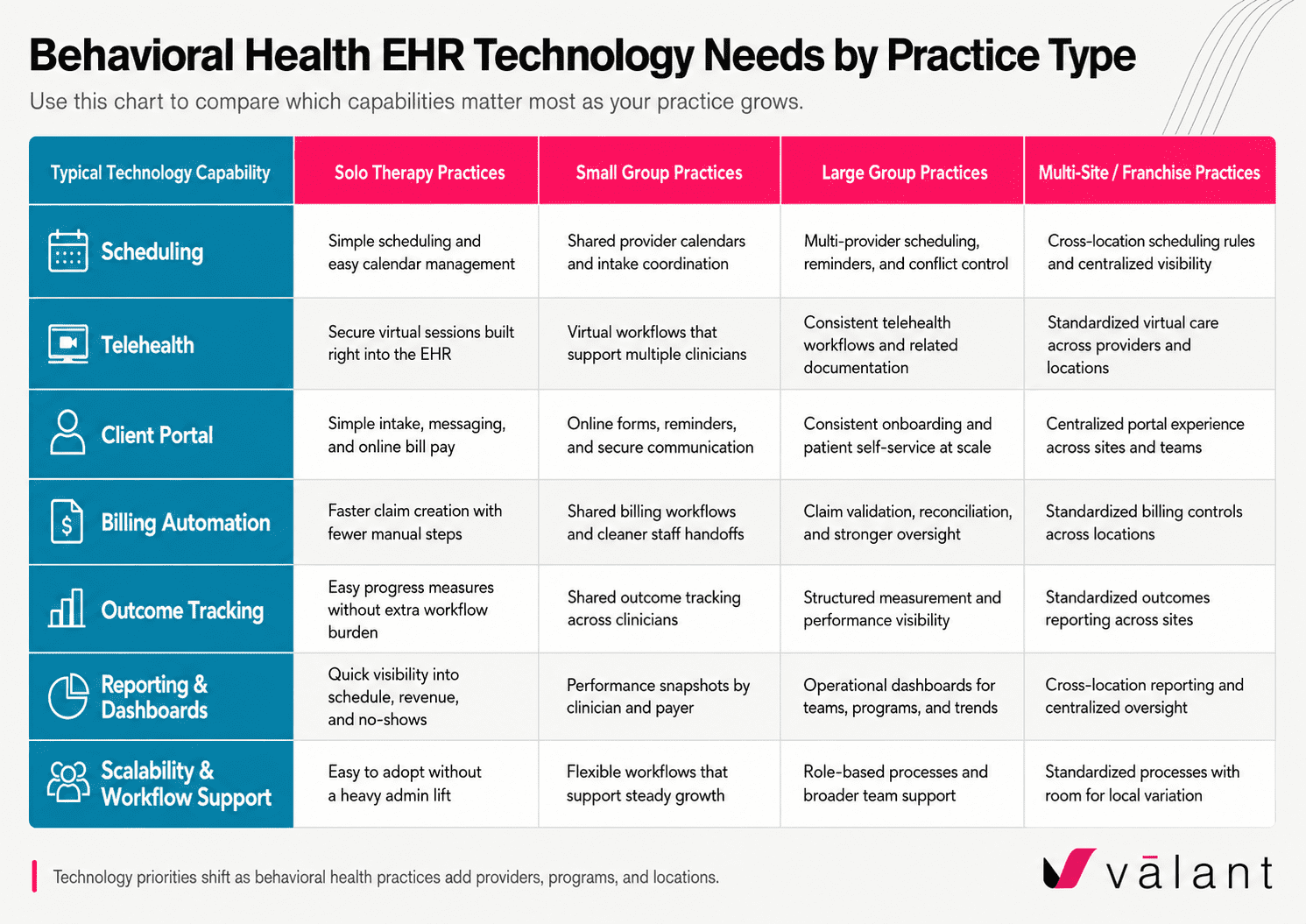
How to Compare EHR Technology by Practice Type
Not every behavioral health practice evaluates technology the same way. A solo therapy practice may care most about ease of use, telehealth, intake, and documentation efficiency. A multi-practice group may need stronger scheduling, reporting, and scalability. IOP/PHP organizations often need more specialized workflows for group scheduling, institutional billing, and program complexity.
As you compare EHR platforms, it helps to ask not only whether a feature exists, but whether it works well for the way your practice actually operates. If you’re evaluating more complex program needs, this IOP/PHP EHR comparison checklist is a helpful next step. If you want a broader sense of what sets one platform apart from another, take a look at The Valant Difference.
Red Flags to Watch for During EHR Evaluation
As you evaluate vendors, pay attention to red flags that suggest the platform may be harder to work with over time. These can include vague answers about deployment, limited support for behavioral health-specific workflows, unclear pricing, weak training, slow product development, or customization processes that are expensive and difficult to manage.
It’s also worth asking how the vendor approaches platform security, data protection, and operational safeguards. This behavioral healthcare data security checklist can help you evaluate that part of the conversation more thoroughly.
If it’s hard to get a straight answer during the evaluation process, that’s worth taking seriously before you sign a contract.
What EHR Training Should Include
Training should go beyond a basic product tour. Your clinicians, front-desk staff, billers, and administrators all use the EHR differently, so their training should reflect the workflows they manage every day. That includes navigation, documentation, scheduling, reporting, patient intake, billing, and any role-specific responsibilities that affect the patient or staff experience.
The more training reflects real use cases, the faster your team can build confidence in the system.
Final Thoughts
Searching for the right EHR can be time-consuming, but finding the right fit for your behavioral health practice is critical and can save your practice countless hours of efficiency in the long run. This EHR technology checklist is a good place to start.
Then, make sure you and other stakeholders within your practice take the opportunity to see a live demo of how the software will operate for a practice like yours. It’s one of the best ways to understand how the software would support your practice in the real world.
Ready to evaluate Valant’s Behavioral Health EHR Software? Check out a pre-recorded demo today.